Isolation Is the Dream Killer:
Barbara Sher and the Science of Asking for Help
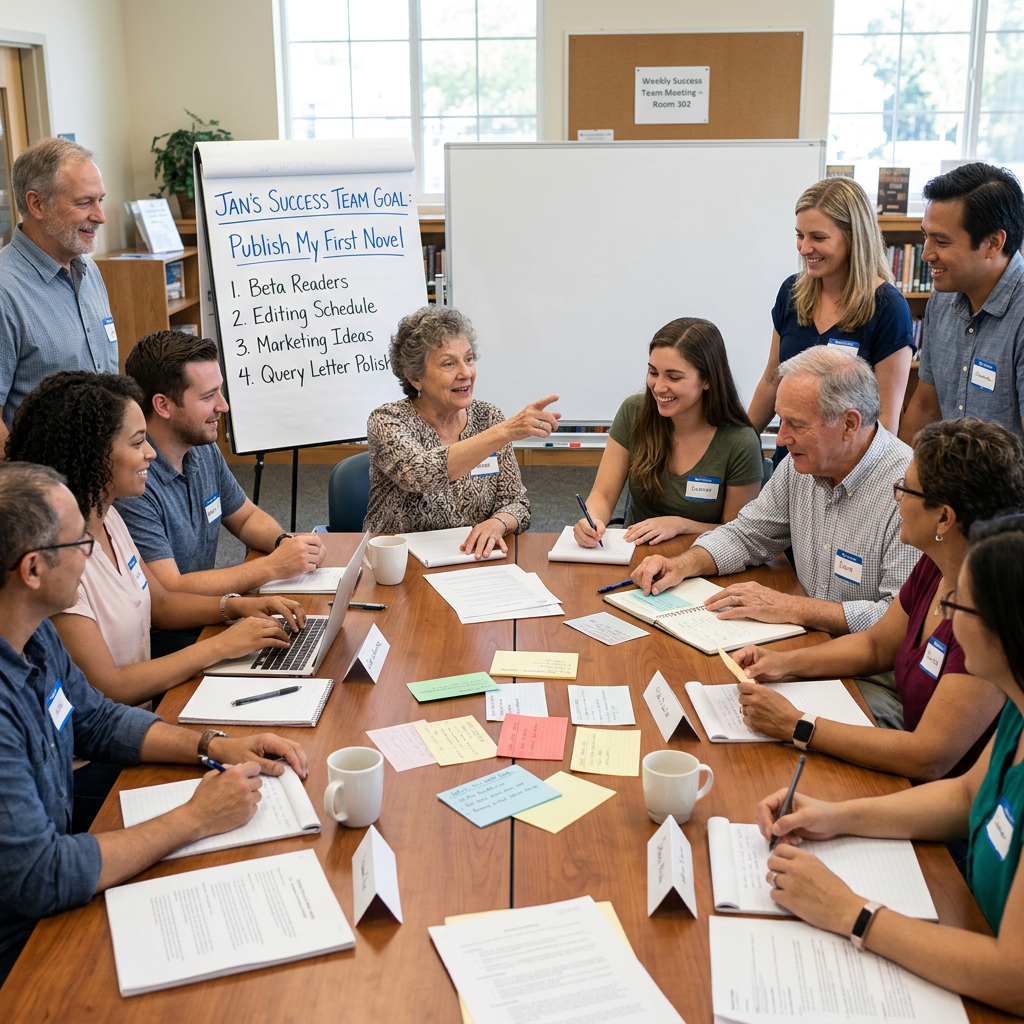
Barbara Sher (1935–2020) spent nearly fifty years helping people figure out what they wanted and then go get it. She wrote Wishcraft and I Could Do Anything If I Only Knew What It Was, and in the 1970s she created small support groups called Success Teams. After watching thousands of people chase their goals, her conclusion was blunt. She even made it the title of her 2015 TEDx talk in Prague: isolation is the dream-killer, not your attitude.
That runs against a lot of self-help advice, which says the problem is your mindset. Sher said the problem is that you’re trying to do it alone. And research on how we size up obstacles, and how people respond when asked for help, suggests she was onto something real.
How a Success Team Works
A Success Team is small, about five or six people, meeting once a week for eight weeks. Members don’t need to share the same goal. In fact, it works better when they don’t. One person wants to open a bakery. Another wants to finish a degree. A third wants to take the trip she’s put off for twenty years. Different goals mean different connections, different skills, and different knowledge in the room.
Each person brings two things to the group: the dream and the obstacle. Or, in plain terms, what they want and why they can’t have it.
The obstacle is the key ingredient. “I can’t do this because…” gives the group something to work on. People start thinking about what they know, who they know, and what they have sitting unused. Someone’s brother-in-law runs a commercial kitchen. Someone else went back to school at 50 and knows which programs work for adults. Resources we never think of as resources show up the moment someone else needs them.
Sher also warned against being too certain about your obstacle. Lack of money, education, or the right circumstances can feel like a dead end. Often it’s a detour you can’t see yet, because the person who knows the way around it hasn’t heard about your problem.
Why It Works: Three Findings from the Research
1. Obstacles look smaller when you’re not alone
In 2008, researchers at the University of Virginia asked people wearing heavy backpacks to estimate how steep a hill was. People standing with a friend judged the hill as less steep than people standing alone. In a second study, participants who simply thought about a supportive friend saw the hill as less steep than those who thought about a neutral or disliked person. The closer and warmer the relationship, the stronger the effect.
A fair note for the skeptics: some researchers argue that findings like this reflect how people judge and report what they see, not a change in vision itself. Either way, the practical point holds. How big a problem seems depends partly on who’s standing next to you. That’s the science underneath Sher’s advice not to trust your first read on an obstacle.
2. People are more willing to help than you think
Francis Flynn of Stanford and Vanessa Bohns (published then as Vanessa Lake) ran a series of studies on asking for help. Across lab experiments and real-world settings, people underestimated by as much as 50 percent how likely others were to say yes to a direct request. In one study, charity fundraisers predicted they would need to approach about half again as many people as it actually took to reach their goal.
Why the miscalculation? When we’re the one asking, we focus on what it costs the other person to say yes. We forget that saying no carries a cost too. Most people don’t like being the one who refuses.
A Success Team is built around this. The format makes asking expected. Nobody has to work up the nerve, and nobody has to guess whether help is welcome.
3. Share the obstacle, not just the announcement
Here’s the twist. Psychologist Peter Gollwitzer and colleagues (2009) found that when people’s identity-related goals were noticed and acknowledged by others, they sometimes put in less effort afterward. Announcing “I’m going to be a writer” can give the brain an early sense of accomplishment, as though saying it counted as doing it.
Sher’s method sidesteps that trap. The group doesn’t just applaud the dream and move on. It goes straight to the obstacle and asks what happens next. Attention stays on the gap between where you are and where you want to be, and that gap is where the work gets done.
Try It Yourself
You don’t need a formal team to use the idea. Pick one thing you want and write two sentences: what I want, and why I can’t have it. Share those two sentences with two or three people whose judgment you trust, and ask one question: “What do you know that I don’t?”
Then listen, and resist the urge to defend your obstacle. That urge is usually the certainty Sher warned about.
Barbara Sher’s TEDx talk: Isolation Is he Dream-Killer, Not Your Attitude
Disclaimer: This post shares information considered reliable from various sources. It is intended as information only and is not intended as advice to engage in any specific physical or mental activity. Always consider whether this information is appropriate for you and always confer with your health professionals.
Discover more from Kevin Rogers Hypnosis
Subscribe to get the latest posts sent to your email.