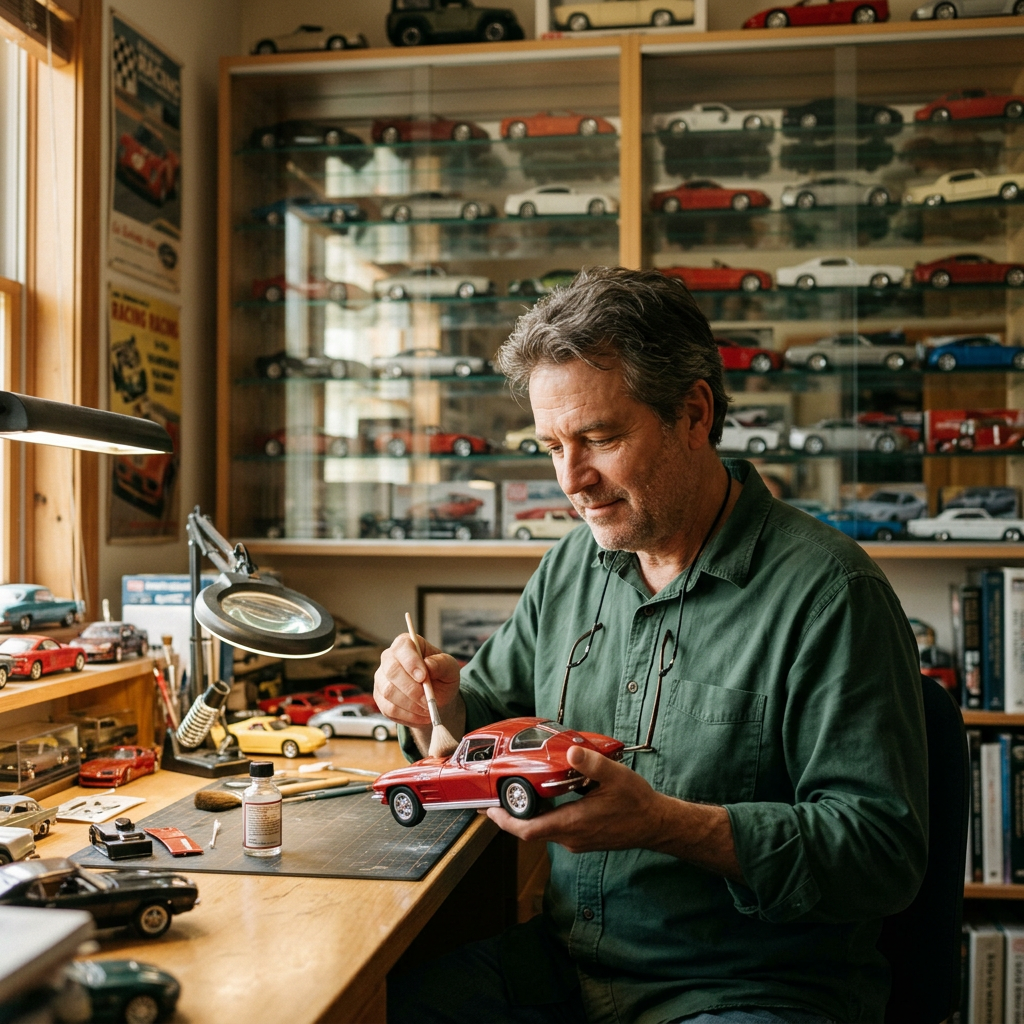
The Collector’s Brain
Why sorting your records, CDs, and model cars is quietly training the same mental machinery you use to run your life.
Picture someone flipping through a crate of records at a yard sale. Thumb, thumb, thumb, pause. To an onlooker it looks like killing time. Inside that person’s head, something much busier is going on. They are holding a mental want-list, matching labels and catalog numbers against it, judging condition, checking the price against a budget, and deciding in about four seconds whether this one comes home.
That is not idle browsing. That is a workout for the part of the brain that plans, organizes, and decides. This article looks at what the research actually says about collecting, where the evidence is strong, where it is thinner, and how to use a collection on purpose as a tool for focus and as a daily reset for an overloaded nervous system.
You Are in Good Company
Collecting is not a fringe quirk. Researchers at King’s College London who study the line between collecting and hoarding estimate that roughly a third of adults collect something. Stamps, coins, vinyl, die-cast cars, baseball cards, cameras, fountain pens. The objects change. The behavior is remarkably consistent.
For most of the twentieth century, psychology treated collecting with suspicion, usually as a symptom of some unresolved childhood need. That view has largely given way. The more recent research looks at collecting the way it looks at any other serious leisure pursuit: what does it ask of the person, and what does it give back?
What Collecting Actually Asks of the Brain
In one of the more cited papers on the subject, psychologists William McIntosh and Brandon Schmeichel examined collecting through the lens of social psychology. Their conclusion was simple and useful: collectors are drawn to collecting because it sets up goals that are tangible, attainable, and provide concrete feedback on progress. It also satisfies a basic human appetite for challenge.
Think about how rare that combination is in adult life. Most of what we work toward is abstract, slow, and judged by someone else. A promotion. A savings goal. A relationship. A collection is different. You can see the gap on the shelf. You can see it close. The feedback is immediate, physical, and entirely yours.
That structure matters because it is exactly the structure the brain’s planning systems are built to run.
Collecting as Executive Function Practice
“Executive function” is the umbrella term for the mental skills that let you manage yourself: plan, organize, stay on task, and make decisions. Developmental neuroscientist Adele Diamond, whose review of the field is one of the most widely used references, breaks it into three core skills. Every one of them shows up in a serious collection.
1. Working memory: holding the list in your head
Working memory is your mental scratchpad, the ability to hold information in mind while you use it. The collector scanning a bin is holding a want-list, a sense of what they already own, the pressing or variant that matters, and a price ceiling, all at once, while their eyes move across new information. That is working memory under load, in a setting where you actually want to do it.
2. Inhibitory control: walking away from the shiny thing
Inhibitory control is the ability to override an impulse. Every collector knows this one. It is passing on the overpriced copy, waiting for the right condition, sticking to the budget, and not buying the thing that is merely tempting because it is not part of the collection. Each time you say, “not this one,” you rehearse the same restraint you need at the grocery store, in an argument, or at 11 p.m. with the phone in your hand.
3. Cognitive flexibility: re-sorting the shelf
Cognitive flexibility is the ability to shift perspective and switch rules. A record collection can be organized by artists, by label, by year, by genre, by country of pressing. A model car collection can be sorted by manufacturer, era, scale, or the real car it represents. Deciding how to categorize, and re-categorizing when the system stops working, is flexibility training. You are asking the brain to look at the same objects through a different lens.
Plus the higher-order skills built on top
Diamond describes planning, reasoning, and problem-solving as higher-level skills built from those three. Collecting uses all of them: budgeting across months, researching what a fair price looks like, tracking down a seller, building a cataloging system, deciding what to trade away to make room. It is project management with a reward at the end.
An honest note on the evidence. No one has run a controlled trial showing that collecting model cars raises executive function scores. What the research supports is that collecting draws on the same skills, and that demanding, learning-heavy hobbies can produce measurable cognitive gains. That leads to the next point, which is the one that matters most for how you collect.
Why the Learning Part Matters
The best experimental evidence on hobbies and the aging brain comes from the Synapse Project at the University of Texas at Dallas, led by cognitive neuroscientist Denise Park. More than two hundred adults aged 60 to 90 were randomly assigned to spend about fifteen hours a week for three months either learning a demanding new skill (digital photography, quilting, or both) or doing easier activities: socializing, or low-effort tasks at home like listening to music or doing simple puzzles.
Only the groups that faced sustained mental challenge improved their episodic memory, the memory for specific events and experiences. The photography group, which had the newest information to learn, gained the most. The comfortable, familiar activities did not produce the same effect.
That finding is the key to collecting as a brain skill. Collecting can be passive, simply buying more of the same and putting it on a shelf. Or it can be active: learning matrix numbers and pressing variants, studying the history of a die-cast manufacturer, figuring out how to grade condition, teaching yourself to spot a reproduction. The second version looks a lot like what the Synapse Project tested. The brain benefits in the learning, not the owning.
The Dopamine of the Hunt
Ask any collector what the best part is, and most will tell you it is the search, not the having. The neuroscience lines up with that answer.
The brain’s dopamine system, running from the ventral tegmental area to the striatum, is less a pleasure system than an anticipation and learning system. It fires hardest when a reward is possible but uncertain, and it spikes when something turns out better than expected. Researchers call that a reward prediction error. The record you did not expect to find in a thrift-store bin is a textbook example.
Neuroscientist Shirley Mueller, who has written extensively on the psychology of collectors, makes the point that collecting engages this reward circuitry without the costs that come with alcohol, gambling, or nicotine. Collecting gives the motivation system a steady, healthy supply of what it is built to chase: a goal, a search, and the occasional unexpected win.
There is also the pull of the incomplete set. The mind treats an unfinished task as an open loop and keeps returning to it, a pattern psychologist have studied since Bluma Zeigarnik’s experiments in the 1920s. A gap in the run of a series keeps attention engaged. In a healthy collection, that open loop gives a sense of direction. When it starts producing distress instead of interest, that is a signal worth listening to, which we will get to below.
Every Object Is a Memory Cue
Pick up almost any item in a long-held collection and the owner can tell you where they found it, who they were with, what the weather was like, and what they paid. That is not sentimentality. That is how memory works.
The hippocampus stores experiences tagged with context: place, time, emotion. A physical object linked to a vivid episode becomes a retrieval cue, a handle that pulls the whole memory back up. A collection, in that sense, is an external memory system. It is your own life, catalogued on a shelf. For older adults especially, a collection is a ready-made tool for reminiscence and conversation.
What It Does for Stress and Wellbeing
There is no large study on collectors specifically and stress hormones. There is, however, solid research on enjoyable leisure activities in general, and collecting fits squarely inside that category.
A study published in Psychosomatic Medicine (Pressman and colleagues, 2009) combined data from nearly 1,400 adults. People who engaged more often in a range of enjoyable leisure activities had lower blood pressure, lower total cortisol, smaller waist circumference, and lower body mass index. They also reported better mood and fewer depressive symptoms. Those associations held after controlling for demographic differences.
A much larger study in Nature Medicine (Mak and colleagues, 2023) followed more than 93,000 people aged sixty-five and older across sixteen countries. Having a hobby was linked to fewer depressive symptoms and higher happiness, self-rated health, and life satisfaction, with life satisfaction showing the strongest link. The pattern held across very different cultures.
Both studies are observational, so the arrow likely runs both ways: healthier people take up hobbies, and hobbies help keep people healthier. Even so, the consistency is hard to ignore.
Research by Brian Spaid and Joseph Matthes at Marquette University adds a piece specific to collectors. In a survey of US collectors, the strength of a person’s collector identity was linked to collecting behaviors that in turn related to life satisfaction. Being “a collector” is part of who someone is, and that sense of identity appears to matter.
How It Spills Over Into the Rest of Life
The skills collecting exercises are not locked inside the hobby. They are the same skills that run a household, a job, and a schedule:
- Systems thinking. Someone who has built a catalog for six hundred records has already solved the problem of organizing a garage, a file cabinet, or an inventory.
- Delayed gratification. Waiting six months for the right copy at the right price is the same muscle as sticking to a budget.
- Attention to detail. Spotting the difference between a first pressing and a reissue trains the eye for small but important differences everywhere.
- Research habits. Collectors learn to check sources, compare prices, and spot a fake. That is critical thinking with skin in the game.
- Social connection. Record shows, swap meets, clubs, and online forums put people in regular contact with others who share their interest, one of the most reliable protective factors for mental health.
A word of caution on that list. Psychology has a long and humbling history with “transfer,” the hope that practicing a skill in one place automatically improves it everywhere. Transfer is real but limited. The practical takeaway is that collecting gives you a low-stakes, high-motivation place to practice planning, restraint, and organization. You still have to bring those skills into the rest of your life on purpose. It helps to notice when you are using them.
Collector or Hoarder? Where the Line Is
Any honest article on collecting has to address this. The American Psychiatric Association draws the distinction clearly. Collectors acquire in an organized, intentional, targeted way, focused on a particular theme, and they organize, display, and admire what they own. Hoarding is marked by impulsive acquisition with little planning, no consistent theme, disorganized clutter that disrupts living space, and real distress at the thought of parting with things.
In other words, the difference is not how much you own. It is whether the executive functions described above are in charge. A quick self-check:
- Can you describe what your collection is, and what does not belong in it?
- Do you know roughly what you have and where it is?
- Do you have a spending limit, and do you keep to it?
- Can you sell, trade, or give away a duplicate without real distress?
- Do your living spaces still work for their intended purpose?
If the answers are yes, your collection is doing what a good collection should. If several are no, and especially if the collection causes conflict, financial strain, or anxiety, it is worth talking to someone.
The Collection as a Neural Reset Protocol
Here is where collecting becomes more than a hobby and turns into a tool.
Your nervous system was built to handle a threat, then return to baseline. Modern life rarely allows the return. Messages, alerts, deadlines, and news keep sending small alarm signals all day long, and the system never fully resets. Directed attention, the effortful focus you use for work, gets depleted as well.
Environmental psychologists Rachel and Stephen Kaplan described what helps that depleted attention recover. They called it “soft fascination,” activity that holds your interest gently, without demanding effortful focus. Watching clouds. Walking in the woods. And, for the right person, carefully cleaning and filing a stack of records. Handling familiar objects, one at a time, with a clear and simple goal is close to an ideal soft-fascination task.
Put that together with a fast-acting breathing technique and a clear ending, and you have a practical reset you can run in about twenty minutes:
- Set the boundary. Phone in another room. One shelf, one box, or one category. A small, defined task with a clear end point.
- Downshift first. Before you start, take three to five slow “cyclic sighs”: a full inhale through the nose, a second short top-up inhale, then a long, slow exhale through the mouth. Research from Stanford (Balban and colleagues, 2023) found that a daily practice of cyclic sighing improved mood and lowered breathing rate more than mindfulness meditation in that study. The long exhale signals the parasympathetic system to take over.
- Work with your hands, one item at a time. Clean, sleeve, file, or catalog. Let your attention rest on the object in front of you: the label, the details, the condition. When your mind drifts to the day’s problems, bring it back to the object. This is soft fascination doing its work.
- Learn one thing. Look up one detail you did not know: a pressing variant, a production year, a manufacturer’s history. A small dose of the novel learning that the Synapse Project found matters most.
- Close the loop. Finish the shelf. Log what you did. Put everything back. Ending with a completed task gives the brain the closure that an open-ended day almost never provides.
What makes this work is the contrast. A day of constant alerts asks you to react to everything. A curating session asks you to attend to one thing, with your hands, toward a finish line you choose. For a nervous system stuck in “on,” that is exactly the signal it needs to start stepping down.
Hypnosis works on the same principle, from the inside. A guided session narrows attention, slows the breath, quiets the background alarms, and lets the system return to baseline. That return is often deeper and faster than people expect. If your system has been stuck “on” for a long time and a hobby alone is not enough to reset it, that is exactly the kind of work we do at Rogers Hypnosis.
How to Collect for Your Brain
If you want your collection to work as a brain skill and not just a shelf, a few principles help:
- Define the focus. A clear theme forces decisions, and decisions are where executive function gets its exercise.
- Keep a catalog. Spreadsheet, notebook, or app. Building and keeping up the system is the organizing workout.
- Set a budget rule and keep it. That is inhibitory control practice with real consequences.
- Learn something with every addition. The learning, not the owning, drives the cognitive benefit.
- Re-sort occasionally. Try a new organizing scheme once a year. That is flexibility training.
- Share it. Show someone, join a club, trade online. The social side is part of the benefit.
- Use it as a reset. Twenty minutes with the collection, phone out of the room, can do more for a tired brain than an hour of scrolling.
A collection is not clutter with a story. It is a system you built, maintain, and keep learning from. The brain that runs it is the same brain that runs your life, and it gets better with practice.
Disclaimer: This post shares information considered reliable from various sources. It is intended as information only and is not intended as advice to engage in any specific physical or mental activity. Always consider whether this information is appropriate for you and always confer with your health professionals.
Discover more from Kevin Rogers Hypnosis
Subscribe to get the latest posts sent to your email.