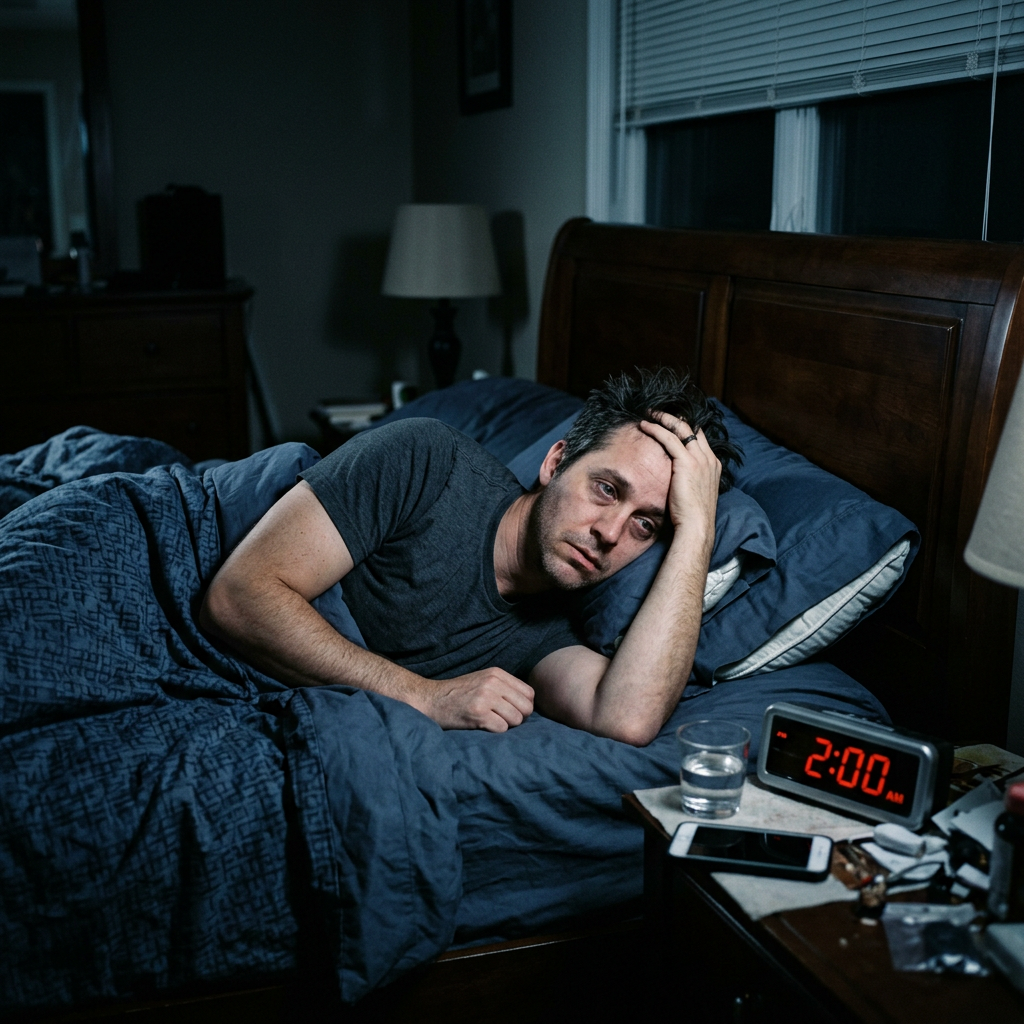
The Alarm That Never Shuts Off
Your nervous system was built for short emergencies followed by a full reset. Modern life can keep the reset from fully finishing, and you carry the difference to bed.
Picture a zebra grazing on the savanna. A lion breaks from the tall grass. In an instant, the zebra’s heart pounds, its muscles flood with fuel, and it runs for its life.
Thirty seconds later, it’s over. After the zebra got away, something remarkable happens next: it goes back to grazing. Its body stands down. Its system resets.
Stanford neuroscientist Robert Sapolsky built an entire book around that scene, Why Zebras Don’t Get Ulcers. His point is simple. The stress response evolved for short, sharp, physical emergencies. Humans run the same ancient machinery, but we switch it on for things that never end: the bill, the meeting, the email, the conversation we keep replaying. And we leave it on.
If you lie in bed at night feeling tired but wired, that’s where the story starts. Not in your bedroom, but in a system that was designed to switch off and, for many people, no longer turns off completely.
Built for the Sprint
The autonomic nervous system runs the parts of your body you don’t consciously control: heart rate, breathing, digestion, blood pressure. It has two main branches.
- The sympathetic branch is the accelerator. It’s the “fight or flight” system that speeds the heart, sharpens attention and readies the body for action.
- The parasympathetic branch is the brake. Working mainly through the vagus nerve, it slows the heart and shifts the body toward rest, digestion and repair.
Most people picture these as a seesaw, where one side goes up and the other goes down. A better picture is a car with the brake gently pressed. Your heart has a built-in pace that’s considerably faster than your resting heart rate. The reason you rest lower is that the vagus nerve is actively holding it back, all the time.
When a threat appears, one of the first things your body does is ease off that brake. Then the accelerator kicks in. Adrenaline hits within seconds. A slower hormonal wave follows, led by cortisol, which typically peaks around 20 to 40 minutes after a stressful event and can take an hour or more to settle back down.
That design makes perfect sense for a zebra. Surge, survive, reset. The problem is the last step. The reset takes time, and it only finishes if nothing sets the alarm off again.
The Cost of Never Finishing
In 1998, neuroendocrinologist Bruce McEwen gave this problem a name. He distinguished between allostasis, the body’s healthy ability to “achieve stability through change,” and allostatic load, “the wear and tear that results from chronic overactivity or underactivity” of those same stress systems.
McEwen described several ways that load builds up. Three of them read like a description of a modern workday:
- Repeated hits. Frequent small stressors, one after another, each one triggering another response before the last has cleared.
- Failure to adapt. Some stressors never become routine. The body keeps reacting as if each one is new.
- Failure to shut off. The response doesn’t end when the threat does. McEwen pointed to blood pressure that, in some people, fails to come back down after an acute stressor has passed.
He noted something else that matters a great deal for sleep: anticipation alone can trigger stress hormones. The event doesn’t have to be happening. It doesn’t have to be real. Thinking about it is enough.
The Ping Isn’t the Problem. The Replay Is.
It’s tempting to blame the phone. Every buzz, banner and alert is a tiny alarm.
Those pings do matter. In a study from the University of British Columbia, 124 adults spent one week checking email only three times a day and another week checking as often as they liked. During the limited week, they reported less daily stress, even though their workload hadn’t changed and most of them found the limit hard to keep.
But a single notification produces only a small, brief response. On its own, it would clear quickly. The bigger problem is what the mind does with it afterward.
Dutch psychologist Jos Brosschot and his colleagues call this perseverative cognition: worrying about what’s coming and ruminating over what already happened. Their argument is that most real stressors are short. What keeps the body’s alarm running is the thinking that stretches them out, both before the event, as it’s anticipated, and after it, as it’s replayed in the mind.
The ping lasts two seconds. The thinking about it can last all evening.
The research on this is consistent. When studies are pooled together, worry and rumination are associated with higher heart rate and blood pressure, higher cortisol and lower heart rate variability, a sign that the body’s brake is weaker. The effects in any single moment are modest. The issue is how many moments there are.
One study makes the point especially clear. Brosschot’s team found that people’s daily worry was linked to lower heart rate variability not only during the day but also during the following night’s sleep. The worry had ended. The person was asleep. Their body was still carrying it.
It also matters how we dwell on something. Research on work stress has found that emotionally chewing over the day after hours is linked to poorer sleep and more fatigue, while practical problem-solving about the same issues is far less harmful. Turning a problem over to fix it is one thing. Circling it with dread is another.
The Brain Needs a Reason to Stand Down
Here’s the part most people never hear.
Brosschot’s later work led to an idea called the generalized unsafety theory of stress. It proposes that the stress response isn’t something the brain switches on only when danger appears. It’s closer to the brain’s default setting. What switches it off is an active signal of safety.
If that’s right, then the absence of a threat isn’t enough. The brain has to register that things are actually okay before it releases the brake on the alarm.
Now think about what a typical day gives the brain to work with. Open loops. Unanswered messages. Tomorrow’s meeting. Headlines. A to-do list that never reaches zero. None of these are lions. But none of them ever fully resolve, either. There’s never a clear moment when the threat is over and the zebra goes back to grazing.
So the system never fully resets. The brake never comes all the way back on. Instead of a sharp spike followed by a return to baseline, you get a slow, steady pressure that never quite drains.
What You Carry to Bed
Sleep doesn’t start from zero. It starts from wherever your nervous system is when your head hits the pillow.
Researchers at the University of Fribourg showed this directly. When people experienced a stressful task before a nap, they took longer to fall asleep and had less deep, slow-wave activity early in their sleep. The stress didn’t stay in the afternoon. It came to bed with them.
People with chronic insomnia often show signs of the same thing on a larger scale: a nervous system running hotter than it should across the whole day and night, with more fight-or-flight activity around the time they’re trying to fall asleep.
Interestingly, the same Fribourg lab found that using social media before bed did not strongly disturb sleep in healthy young people. That’s a useful reminder. The screen itself isn’t the villain. The unfinished business it delivers, the thinking it over, is the concern.
Why This Matters for Tonight
If you’ve ever wondered why you can feel exhausted and still be unable to sleep, this is a large part of the answer. Tiredness and alertness are run by different systems. You can have plenty of sleep pressure built up and still have an alarm that hasn’t been told to stand down.
It also explains why “just relax” rarely works. You can’t order the brake back on. It responds to signals of safety and resolution, not to commands.
The good news is that the system is still working exactly as designed. It isn’t broken. It’s doing its job in an environment that never lets it finish. And a system that responds to signals can be given better ones.
The Bottom Line
- The nervous system was built for short emergencies: a fast surge, then a full reset.
- The reset takes time, and it only finishes if nothing re-triggers the alarm.
- Modern life rarely delivers a clear “all clear.” Constant small events, plus a mind that replays and anticipates them, keep the brake from coming back on.
- Worry from the day can still be measured in your body during that night’s sleep.
- The brain doesn’t stand down just because the threat is gone. It stands down when it registers safety.
Next in the series: Part 2, You Don’t Drift Off. You Switch Off. What happens at bedtime when a loaded alarm system meets the brain’s sleep switch, and why trying harder only makes it worse.
Disclaimer: This post shares information considered reliable from various sources. It is intended as information only and is not intended as advice to engage in any specific physical or mental activity. Always consider whether this information is appropriate for you and always confer with your health professionals.
Discover more from Kevin Rogers Hypnosis
Subscribe to get the latest posts sent to your email.