You Don’t Drift Off. You Switch Off.
Falling asleep is a handoff between two competing brain systems, and the side you bring to bed loaded usually wins
Ask most people how they fall asleep and they’ll describe a slow fade. The room gets quieter, the thoughts get blurrier, and eventually you’re asleep. It feels like a dimmer switch being turned down a little at a time.
That feeling is real. The explanation behind it is wrong, and believing it is one reason so many people lie awake at night.
In Part 1, we saw how modern life keeps the body’s alarm system from ever finishing its reset, so many of us arrive at bedtime with the stress response still running. This part looks at what happens next, when that loaded alarm meets the brain’s sleep machinery.
Your brain doesn’t ease from wake into sleep. It runs two opposing systems, one that keeps you awake and one that puts you to sleep, and they compete for control. When one gets enough of an edge, it shuts the other down, and the state flips. Sleep isn’t something you drift into. It’s a switch that gets thrown.
Two Systems, One Switch
Deep in the brain, a small cluster of sleep-promoting neurons in the hypothalamus (the ventrolateral preoptic nucleus, or VLPO) sits opposite a network of wake-promoting cell groups in the brainstem and hypothalamus. These are the arousal systems that keep you alert, oriented and ready to respond.
The two sides don’t cooperate. They inhibit each other. When the sleep side is active, it silences the wake side. When the wake side is active, it silences the sleep side. Harvard neurologist Clifford Saper and colleagues named this arrangement a “flip-flop switch,” borrowing the term from electrical engineering.
A flip-flop circuit has a useful property: it avoids the middle. Because each side suppresses the other, the system is stable at either end and unstable in between. When one side gets even a small advantage, the opposition weakens, which strengthens that side further, and the whole thing snaps over. Saper’s group has proposed that this is why the transition between waking and sleeping is generally rapid and complete, and why we describe the moment as falling asleep.
A third player keeps the switch from flipping at the wrong time. Neurons that produce orexin (also called hypocretin) reinforce the wake side during the day, acting like a finger holding the switch in place. When orexin signaling is lost, as in narcolepsy, the switch becomes unstable. People slip into sleep during the day and wake repeatedly at night, spending far more time in odd in-between states.
So under normal conditions, the brain isn’t designed to drift. It’s designed to choose.
Then Why Does It Feel Like Drifting?
If the switch is fast, why does falling asleep feel gradual? Because the switch doesn’t flip everywhere in the brain at the same instant.
In a 2010 study published in PNAS, French researchers recorded electrical activity directly from deep inside the brains of patients being monitored for epilepsy. They found that the thalamus, the relay station that passes sensory information up to the cortex, went offline first, often several minutes before the cortex followed. Even within the cortex, different regions deactivated unevenly.
In other words, the control center throws the switch, cuts the cortex off from incoming signals, and the thinking, aware part of the brain catches up over the next few minutes. The researchers suggested that this lag explains two familiar experiences: the dreamlike images and fragments people see as they nod off, produced by a cortex that’s still partly running, and the common tendency to overestimate how long it took to fall asleep.
That’s the drift you feel. It isn’t sleep slowly taking over. It’s the conscious part of your brain lagging behind a decision that has already been made underneath it.
What Tips the Balance
Two forces normally push the switch toward sleep at night: sleep pressure, which builds the longer you’re awake, and your circadian clock, which signals that it’s biologically night. On a typical evening, those forces gradually load the sleep side until it wins and the switch flips.
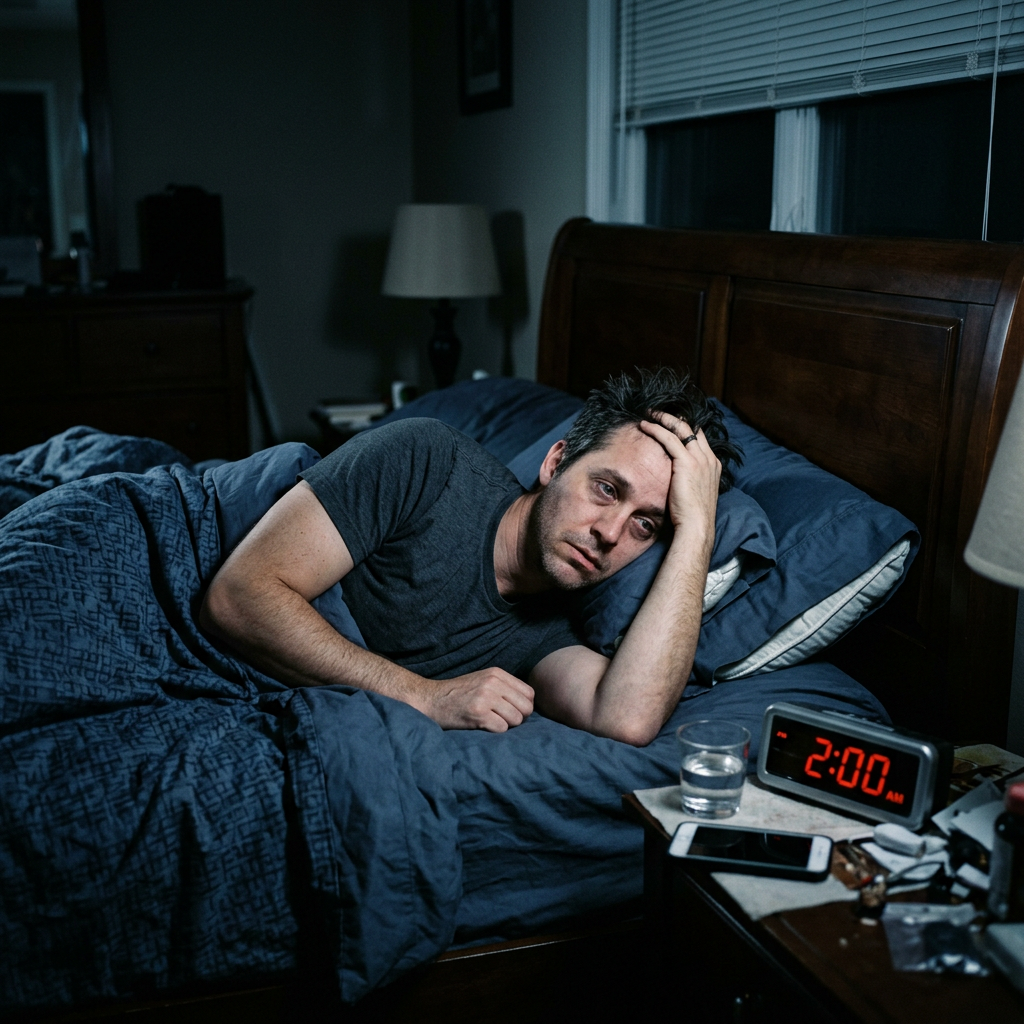
But the wake side has its own fuel, and that’s where most sleep trouble begins. Anything that drives arousal, including stress hormones, a racing heart, vigilance, worry, problem-solving or simply paying close attention, feeds the wake side of the switch. The sleep side can be fully loaded and still lose, because the wake side is being pushed harder.
This is where Part 1 and Part 2 meet. An alarm system that never finished resetting during the day is a wake side that arrives at bedtime already loaded. That’s how you can be exhausted and still unable to sleep: plenty of sleep pressure on one side, and an alarm that hasn’t stood down on the other.
The Hyperaroused Brain
Sleep researchers have a name for this pattern: hyperarousal. It’s one of the most consistent findings in insomnia research. People who struggle to sleep show elevated arousal across several systems at once:
- Physiological arousal: higher stress-system activity and sympathetic (fight-or-flight) nervous system output in the period before sleep.
- Cognitive arousal: worry, rumination and racing thoughts that are hard to switch off.
- Cortical arousal: more fast, wake-like brain-wave activity around sleep onset and even during sleep itself.
You don’t need a diagnosis for this to apply. In one experiment, researchers deliberately induced pre-sleep mental arousal in healthy volunteers. Their measured time to fall asleep went up significantly compared with a normal night. Give a good sleeper something to chew on at bedtime and the wake side starts winning.
This is also why stress and anxiety show up so often alongside sleep complaints. They aren’t separate problems sitting next to insomnia. They feed the same side of the same switch.
The Switch Can’t Be Forced
If the wake side is winning, the natural response is to fight back: to try harder to fall asleep. The problem is that trying is itself wake-side activity. Two experiments make the point.
- When Harvard psychologist Daniel Wegner’s team told people with busy minds to fall asleep as fast as they could, they took longer than people who were told to fall asleep whenever they liked.
- When researchers at the University of Fribourg told healthy sleepers to sleep badly on purpose, their sleep objectively got worse. When they told them to sleep well, nothing changed. Intention could push the switch toward wake, but not toward sleep.
You can’t flip this switch by willpower, because willpower runs on the wake side. Part 3 looks at the subtler ways we keep feeding it, from watching the clock to trying to relax, and what to do instead.
The Bottom Line
- Falling asleep isn’t a slow fade. It’s a competition between a wake system and a sleep system that inhibit each other, ending in a fast flip.
- The drifting feeling comes from the thinking part of your brain catching up a few minutes after deeper structures have already switched over.
- Sleep pressure and your body clock load the sleep side. Stress, worry and vigilance load the wake side.
- A stress response that never reset during the day arrives at bedtime as a wake side that’s already winning.
- Trying to force the switch only adds weight to the wrong side.
Next in the series: Part 3, The Night Watchman. Why pushing for sleep, watching for sleep and fighting your own mind all keep you awake, and what to do instead.
Disclaimer: This post shares information considered reliable from various sources. It is intended as information only and is not intended as advice to engage in any specific physical or mental activity. Always consider whether this information is appropriate for you and always confer with your health professionals.
Discover more from Kevin Rogers Hypnosis
Subscribe to get the latest posts sent to your email.