Updated October 2026. This replaces my August 2024 post.
The idea.
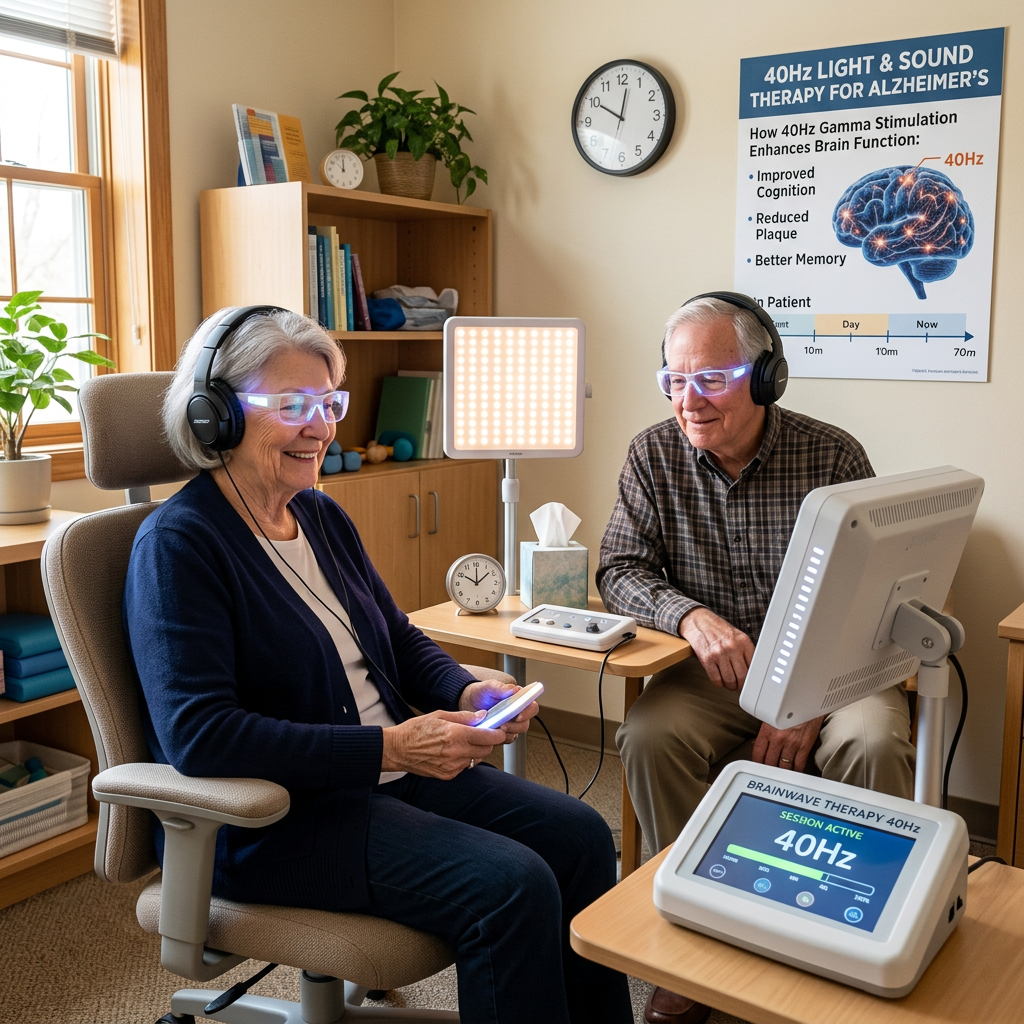
Flicker a light 40 times per second and the visual part of your brain answers back at 40 Hz. That part isn’t speculation — it shows up on an EEG within seconds. What researchers have spent the last decade asking is what that response actually does, and for whom.
Where it started.
In 2016, Li-Huei Tsai’s lab at MIT reported that one hour a day of 40 Hz flickering light reduced amyloid beta — a hallmark Alzheimer’s protein — in the visual cortex of mice bred to develop Alzheimer’s-like disease. In 2019 they added 40 Hz sound alongside the light and saw the effect spread to memory regions, with better memory performance in the mice. The method got a name: GENUS, for Gamma ENtrainment Using Sensory stimuli.
Why 40 Hz? Gamma rhythms (roughly 30–100 Hz) appear when the brain is actively binding information together — attention, working memory, perception. In Alzheimer’s, gamma activity is disrupted.
How it might work.
In 2024 the MIT group published a mechanism in Nature, again in mice. Combined light-and-sound stimulation boosted the glymphatic system — the brain’s fluid-based rinse cycle. A specific type of neuron (VIP interneurons) released signaling peptides that increased the pulsing of blood vessels, pushing cerebrospinal fluid through brain tissue and carrying amyloid out. When the researchers blocked that drainage route, the amyloid clearance disappeared.
The skeptic’s column.
Not every lab gets the same result. In 2023, György Buzsáki’s group at NYU reported in Nature Neuroscience that 40 Hz flicker produced a 40 Hz response in visual cortex but did not entrain the brain’s native gamma rhythm, reached deeper memory structures only weakly, and did not reliably reduce amyloid. A separate 2023 study in eNeuro also found no amyloid reduction from light flicker alone. The MIT team replied that differences in methods and definitions explain the gap. The honest summary: the brain clearly responds. How far that response travels, and what it does, is still being worked out.
What humans show so far.
- Light alone: an early pilot in six patients (10 days) found no reduction in amyloid.
- Light plus sound: small trials report the treatment is well tolerated, with signs of less brain shrinkage and better sleep over a few months.
- Long-term: in 2025 MIT reported on five patients who used the device daily for about two years. The three women with late-onset Alzheimer’s declined less than matched patients from national databases; the two men with early-onset Alzheimer’s did not benefit. Five people and no placebo group — encouraging, not proof.
- The big test: Cognito Therapeutics’ HOPE trial enrolled about 670 people with mild-to-moderate Alzheimer’s, one hour a day for a year, comparing the real device with a sham. Data collection finished in mid-2026. As of this writing, results have not been made public, and the device is not FDA-approved.
What about stress, mood, and focus?
This is where I have to correct my 2024 version. I wrote that 40 Hz light reduces stress and triggers the relaxation response. The research doesn’t support that. Gamma is an active, processing rhythm — not a calm-down rhythm. One small study in healthy young adults found 40 Hz flickering red light actually reduced sleepiness. And in healthy adults, studies of 40 Hz light have not shown reliable short-term boosts to memory or attention. Trials in depression are under way, with no conclusions yet.
If calm is your goal, the slow end of the brain’s range — theta, slow breathing, hypnosis — is the better-supported route. (See: Theta vs. Gamma: The Two Gears Your Brain Uses to Change.)
Who should skip it.
Flickering light in the roughly 3–70 Hz range can trigger seizures in people with photosensitive epilepsy — and some people don’t discover they’re photosensitive until it happens. Flicker is also a well-known migraine trigger. If you have epilepsy, a seizure history, or migraines, talk with your doctor before trying any flicker device.
A note on consumer gadgets.
Apps, lamps, and glasses sold as “40 Hz” are not the devices used in clinical trials. Research devices are calibrated for brightness, synchronized with sound, and checked against EEG. A flicker app on your phone is a different thing.
Bottom line.
40 Hz sensory stimulation is one of the more interesting ideas in Alzheimer’s research: a real, measurable brain response, a plausible mechanism in mice, promising small human studies, and a large trial waiting to report. It is not a stress tool, not a focus hack, and not yet a proven treatment. Watch for the HOPE results.
Disclaimer: This post shares information considered reliable from various sources. It is intended as information only and is not intended as advice to engage in any specific physical or mental activity. Always consider whether this information is appropriate for you and always confer with your health professionals.
Discover more from Kevin Rogers Hypnosis
Subscribe to get the latest posts sent to your email.