The Breath That Actually Calms You Down (And Why “Take a Deep Breath” Is Half Wrong)
Somebody has told you to take a deep breath. Probably more than once. Probably at the exact moment you least wanted to hear it.
Here’s the strange thing about that advice. It points you at the wrong half of the breath.
The inhale isn’t what calms you down. The inhale is what braces you.
Your heart speeds up when you breathe in
This is easy to check on yourself. Put two fingers on the side of your neck and breathe in slowly and deeply. Your pulse picks up a little. Now let the air out slowly. It settles back down.
That’s not a fluke or a trick of attention. It’s how the wiring works. Breathing in nudges the accelerator. Breathing out taps the brake.
So when someone tells you to take a big deep breath and hold it, they’re handing you the gas pedal and hoping you slow down.
A big inhale does have a use. Before you lift something heavy, before you walk into a hard conversation, before you step out of the truck — bracing is exactly right. That’s a real tool.
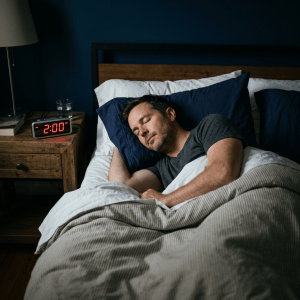
It just isn’t the one you want at 2 a.m. when your brain won’t shut off.
You already do the right thing about twenty times an hour
Here’s the part most people have never been told.
You sigh on your own, every few minutes, all day long. You don’t decide to. You usually don’t even notice. It has its own dedicated circuit in the brainstem, running quietly in the background whether you’re paying attention or not.
It isn’t emotional. It’s mechanical.
Deep in your lungs are millions of tiny air sacs where oxygen crosses into your blood and carbon dioxide comes back out. Over time, some of them quietly collapse. Less surface area. Less efficient trade.
The sigh reinflates them.
That’s it. That’s the whole job. Your body built a reflex to pop those little sacs back open, and it fires it a few times an hour without asking permission.
Which means the calming breath isn’t something exotic you have to learn from scratch. It’s something you already own. You can just do it on purpose.
The ninety-second version
It’s called cyclic sighing. Two parts.
Part one — the double inhale. Breathe in through your nose. Then, right at the top, sip in a second short breath through your nose. Two inhales, stacked, no pause between them.
That second sip is what reopens the collapsed air sacs. It’s small. Don’t force it.
Part two — the long exhale. Let it out slowly through your mouth. Longer than the inhale took. Keep going until your lungs are genuinely empty — past the point where you’d normally stop.
That’s one round.
Then do it again. And once more.
Try three rounds right now, before you keep reading. It takes about thirty seconds and the rest of this will make more sense afterward.
What you probably just noticed
Shoulders dropped a little. Jaw let go. And the breath after the third round arrived slower on its own, without you managing it.
That last part is the one worth sitting with.
You didn’t talk yourself into relaxing. You didn’t visualize a beach. You changed one physical input, and a reflex you don’t control did the work for you.
That distinction matters more than it sounds like it does. Most people’s experience of “calm down” is a losing argument with themselves. This is a different category of thing. It’s closer to flipping a switch than winning a debate.
Does it actually hold up?
Fair question, and it deserves a real answer rather than a testimonial.
Researchers at Stanford ran a randomized study on this in 2023, published in Cell Reports Medicine. Around a hundred people, five minutes a day, for a month. They compared several breathing patterns against mindfulness meditation.
Cyclic sighing came out ahead. Bigger improvement in mood than the meditation group, and a measurable drop in resting breathing rate — meaning the effect didn’t stop when the five minutes ended. It carried.
Five minutes. No app, no equipment, no subscription.
I’ll be straight about the limits, though. One study is one study. The people in it were generally healthy volunteers, not a clinical population. What this tells us is that the technique does something real and measurable — not that it fixes everything.
Where this actually fits
The reason I keep coming back to this one has less to do with the research and more to do with who I work with.
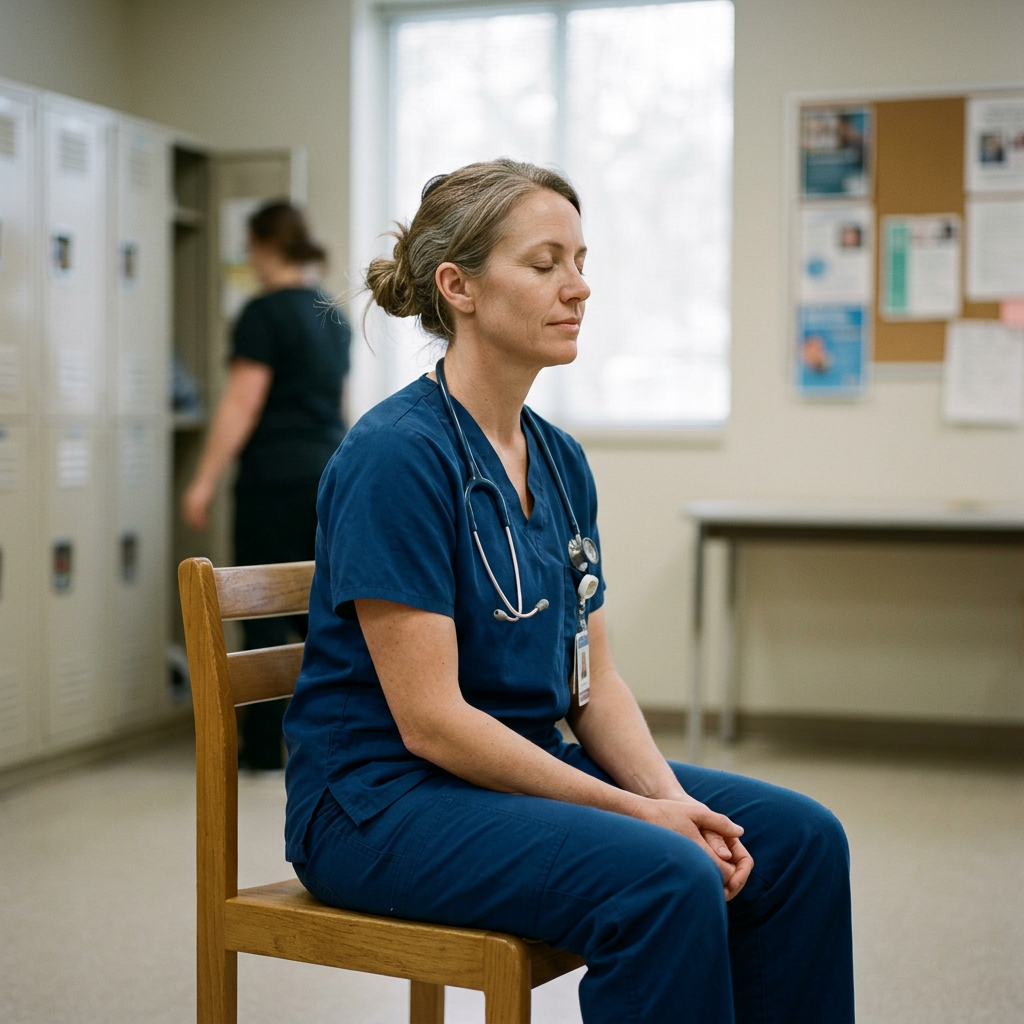
Firefighters. Nurses. Cops. Teachers. Veterans. People whose stress doesn’t arrive on a schedule and doesn’t wait for a convenient twenty-minute window.
Most stress advice quietly assumes you have time and privacy. Sit somewhere quiet. Close your eyes. Give it twenty minutes.
That advice is useless to a nurse between rooms.
This works in the stairwell. In the rig on the way back to the station. In the parking lot at school before third period. In your own driveway, before you walk in the door and become somebody’s parent for the next four hours.
Ninety seconds and nobody has to know you did it.
What it won’t do
I’d rather tell you this than have you find out and decide the whole thing was hype.
Cyclic sighing takes the edge off. It brings you down a notch. For a bad afternoon, a spike of frustration, or a mind that won’t quiet down at bedtime, a notch is often exactly enough.
It is not a treatment for a panic disorder. It won’t resolve trauma. It doesn’t touch the underlying pattern if your sleep has been broken for months, or if the same worry has been running on a loop since spring.
For those, the breath is a good first move and a poor last one. If something in your life feels bigger than a rough day, that’s worth an actual conversation with someone — me or otherwise.
The one thing worth keeping
If you remember nothing else from this: make the exhale longer than the inhale.
Everything else is refinement. That one rule does most of the work, and you can apply it right now without practicing anything.
You already have the reflex. This is just using it on purpose.
Try the interactive version
Nine cards, tap to reveal. The technique’s built into card six — you’ll have done it before you finish.
About Rogers Hypnosis
I’m Kevin Rogers, a Certified Professional Hypnotist in Vestal, New York, working with people across Broome County on stress, sleep, and the things that don’t loosen up on their own. No woo — just how the brain actually works.
Disclaimer: This post shares information considered reliable from various sources. It is intended as information only and is not intended as advice to engage in any specific physical or mental activity. Always consider whether this information is appropriate for you and always confer with your health professionals.
Discover more from Kevin Rogers Hypnosis
Subscribe to get the latest posts sent to your email.