
You may be familiar with the heart rate, but fewer people have heard of something called Heart Rate Variability, or HRV. Simply put, HRV is the variation in time between each heartbeat. While that might sound like something you don’t want—shouldn’t your heart be steady?—the truth is, a healthy heart doesn’t beat like a metronome. It changes rhythm depending on what your body needs at the moment. A higher HRV generally means the system is flexible and responsive, adapting well to stress and relaxation. A low HRV can mean the system is stuck in “fight or flight,” struggling to bounce back.
Why should you care? Because HRV is like a window into the nervous system. It reflects how well the body balances stress and recovery. If HRV is consistently healthy, it usually means the body is handling daily life—physically and emotionally—more effectively. It’s one of the most reliable markers we have for resilience, both mentally and physically.
Research has connected high, stable HRV with lower levels of anxiety and depression, improved sleep, reduced inflammation, and even lower risk of heart disease. People with better HRV tend to recover faster from illness and injury, and often report feeling more mentally clear and emotionally balanced.
On the flip side, low or erratic HRV is often found in people under chronic stress, those with poor sleep, or individuals facing conditions like burnout, or chronic pain. It doesn’t mean something is “wrong,” it simply means the system may need more consistent support to regain its natural balance.
HRV can be trained. I have a 5-minute method that helps clients achieve a consistent HRV pattern naturally. This kind of regulation is the foundation for long-term emotional, and physical, well-being, and focus. This method was designed for anyone interested in reducing the feeling of stress and balancing the nervous system. All that is needed is the willingness to feel better..
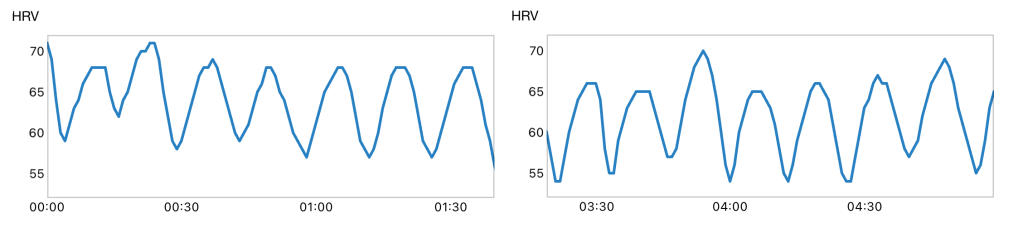
This is an image of my recent HRV on May 19, 2025 using my Resilience Renewal Method. My heart beat is varying from about 70 beats per minute to about 55 beats per minute. The cycle is about 7-8 seconds and this is over a 5 minute period.
Resources Page: Downloads, Guides, Food Lists & Worksheets.
Have a personal interest? Contact me to explore personal interests by clicking the link. Schedule a Callback
Disclaimer: The “Just Suppose Blog” shares ideas in exploring personal progress as derived from various sources. It is intended as information only and is not intended as advice to engage in any specific physical or mental activity. Always consider whether these ideas, concepts, techniques & activities are right for you & always confer with your health professionals.
Discover more from Kevin Rogers Hypnosis
Subscribe to get the latest posts sent to your email.